Chemical-Free
Whole House UV Purifier
Kill 99.99% of bacteria, viruses, and microorganisms without chemicals. The final layer of protection for your family's water.
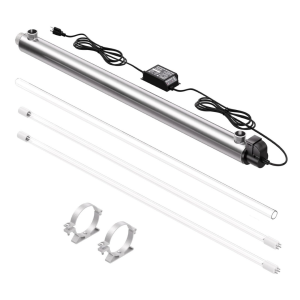
99.99% Germicidal
Lifetime Warranty
Kill 99.99% of bacteria, viruses, and microorganisms without chemicals. The final layer of protection for your family's water.
Ultraviolet light at 254 nanometers disrupts the DNA of microorganisms, rendering them unable to reproduce. It's like giving bacteria and viruses a sunburn they can't survive.
Water flows through the stainless steel chamber around the UV lamp.
254nm UV-C light penetrates microorganisms and destroys their ability to reproduce.
Sterilized water flows to every tap in your home - no chemicals added.
Important: UV systems require clear water to work effectively. Pre-filtration (sediment filter) is required for well water applications.
Essential for well water to eliminate bacteria, viruses, and microorganisms.
Protects your family during boil water advisories and line breaks.
Recommended for elderly, infants, or those with weakened immune systems.
Adds an extra layer of protection to any water filtration system.
UV lamp must be replaced every 12 months for optimal performance.
Clean the quartz sleeve annually to maintain UV transmission.
LED display shows UV intensity and alerts when service is needed.
UV systems work best when paired with other filtration for complete protection.
Product Infosheet
Download the full spec sheet for this system
Houston's municipal water is treated with chloramine before it reaches your home, which handles most biological contamination under normal conditions. For the average city water customer, a UV system is an optional upgrade rather than a necessity. However, it becomes strongly recommended in specific situations: if you've received a boil water advisory in your area, if you have family members who are immunocompromised (elderly, infants, cancer patients, transplant recipients), or if you're removing chlorine with a whole-house carbon filter and want to maintain biological protection after the chlorine is gone. It's also standard on well water systems where there's no municipal treatment at all.
Chlorine kills microorganisms by chemically reacting with them — but it also creates disinfection byproducts (DBPs) like trihalomethanes and haloacetic acids as a side effect, and it doesn't effectively kill some pathogens like Cryptosporidium. UV light works physically, not chemically: it destroys the DNA of microorganisms without adding anything to the water or creating byproducts. It's effective against Cryptosporidium and Giardia, which are chlorine-resistant. The limitation is that UV provides no residual protection — if contamination enters after the UV chamber, there's nothing stopping it. This is why UV works best as part of a layered system, not as a standalone solution.
The UV lamp needs annual replacement — every 9,000 hours of operation, which works out to about 12 months of continuous use. The lamp may still glow after this point, but UV output drops below effective levels, meaning it won't adequately disinfect your water even though it looks like it's working. Our systems include an LED intensity monitor that displays real-time UV output and alerts you when the lamp needs replacement. We recommend setting a calendar reminder at installation. Lamp replacement is a straightforward DIY task that takes about 10 minutes — we walk every customer through the process.
Yes — UV systems are designed to be added to existing installations. The sterilizer is installed on the main water line after any filtration (sediment filters, carbon filters, softeners) and before water enters your home's distribution. The most important requirement is water clarity: UV is only effective in water with low turbidity (less than 1 NTU). If your water has sediment, iron, or particulates that could shield bacteria from the UV light, a pre-filter needs to be in place first. We assess your current setup during the free water test and recommend the right installation point for maximum effectiveness.
No — UV light only destroys biological contaminants (bacteria, viruses, cysts). It has no effect on chemicals, heavy metals, PFAS, chlorine, hardness, or any dissolved substances. It doesn't change the taste, smell, or chemistry of your water at all. If your main concerns are chlorine taste, hard water scale, or chemical contaminants like PFAS, a carbon filter, water softener, or RO system are the right tools. UV is specifically for biological protection. Most whole-home installations in the Houston metro combine a carbon filter + softener (for chemistry) with UV (for biological) — each doing what the other can't.
Add UV sterilization to your water treatment system for complete peace of mind.